Effective business leadership is not from the front
Effective business leadership is not from the front
The biggest misconception in entrepreneurial leadership is that effective leadership requires the leader to lead from the front. It does not.
But before I unpack my reasoning for that statement, it is worth exploring what we actually mean by entrepreneurial leadership.
The simplest definition of leadership is perhaps leading others towards a common purpose. In entrepreneurial leadership, however, there is an important difference. The purpose is not initially a common one. It is your purpose. You defined it, you created it, and it aligns with your vision, which makes the business of leading others towards it deeply personal.
A number of things happen because of this, and one of them is that we tend to believe that, because the purpose is ours, we need to continually “show the way” and lead from the front.
And we do, but only for a time.
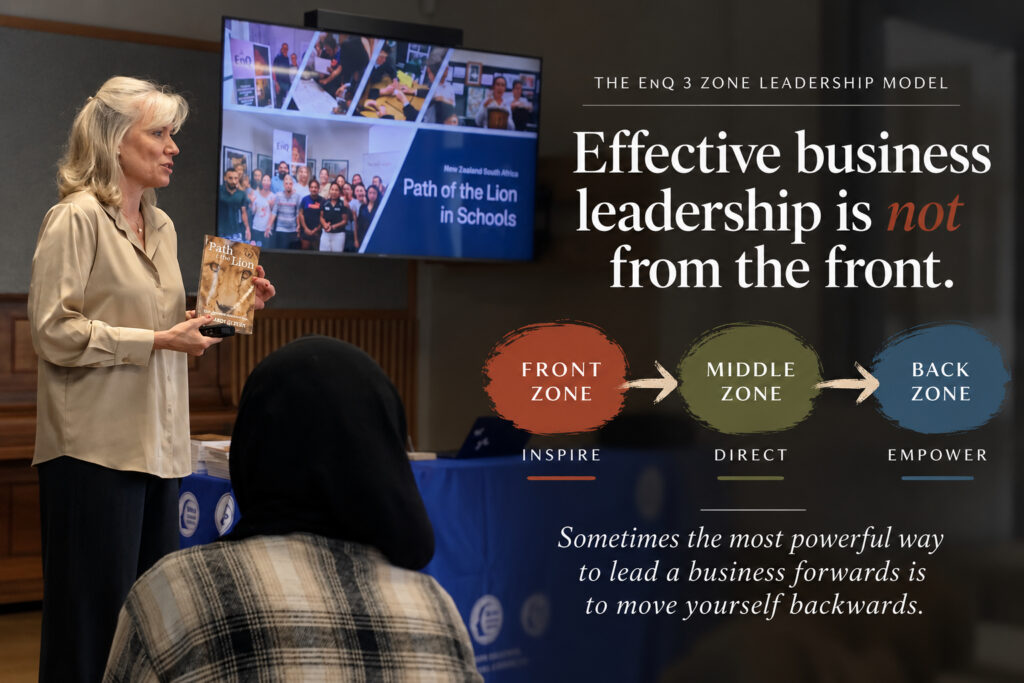
Many years ago, I developed what I called the EnQ 3 Zone Leadership Model, affectionately referred to by some of the entrepreneurs who encountered it in my workshops as the “backwards to forwards model”. Its premise is simple: as a business develops, effective entrepreneurial leadership is not just about how we lead, but increasingly about from where we lead.
There are three positions: the Front Zone, the Middle Zone and the Back Zone.
The Front Zone: conquering
When a business is founded, its leader is often functioning alone, or with a small number of partners or employees. We create the vision and the pathway and then drive the business idea forward through our own energy and action.
Think of the traditional image of a leader on the battlefield: on a horse, sword in hand, shouting, “This way!” as everyone follows.
It is actually a fairly good representation of effective leadership during the founding phase of a business. Products are created, relationships are formed, contracts are sought, and opportunities are pursued. Our attention is largely on the horizon, and success is measured by what we conquer: the client we win, the contract we sign, the market we enter or the idea we turn into something real.
The problem comes when the business changes, but the leader’s position does not.
The Middle Zone: transferring
As the business grows, suddenly there is much more to do than conquer. There is execution, administration, follow-through and follow-up. There are things that don’t work, systems that need to be created, customers who need to be serviced and promises that now have to be delivered.
More people are needed, usually at precisely the point when the entrepreneur is asking, Can I actually afford more people?
This is when the business leader needs to get off the horse and into the trenches.
In my model, this is the Middle Zone, and two important things need to happen here. We need to transfer some of the skills and responsibilities of the Front Zone to other people so that the business can continue conquering without everything depending upon us, and we need to bring in skills that the growing business now requires — often skills that we don’t personally have.
This can be an exhausting phase because building the right team and infrastructure is rarely a straight path. We often have to move through the wrong people, processes and systems before finding the right ones.
Yet the entrepreneur who refuses to enter this zone, who remains determined to control every relationship, decision and function personally, eventually becomes the very thing constraining the business they worked so hard to build.
The Middle Zone is necessary. It is just not somewhere we should live forever.
The Back Zone: seeing
Once the people, responsibilities and systems of the Middle Zone are established, the leader needs to take one more step backwards.
This is the part that can feel counterintuitive, because we have been conditioned to associate visible activity with leadership. Stepping back can feel as though we are becoming less important to the business when, in fact, our leadership can become considerably more valuable.
From the Back Zone, we can see again.
We can see what is happening inside the business without needing to be involved in every part of it. We can look beyond today’s problems towards what is coming next. We can see where the market is shifting, where our relevance may be weakening, where new opportunities are appearing and where the business is becoming too dependent upon old ways of doing things.
Our leadership also changes. In the Front Zone we are largely inspirational: follow me. In the Middle Zone we become more directive: this is what needs to happen. In the Back Zone, effective leadership becomes increasingly empowering: you know what needs to happen; you have what you need to do it; now show me what you can add to it.
That does not mean abandoning accountability or disappearing from the business. Quite the opposite. It means creating sufficient distance to hold people accountable for outcomes rather than remaining entangled in how every outcome is achieved.
And perhaps most importantly, it gives the entrepreneurial leader their horizon back.
After thirty years of building businesses, I think this remains one of the most difficult transitions for founders to make. The qualities that help us create a business, energy, control, personal involvement, persistence and an instinct to make things happen ourselves, can eventually become the qualities that prevent that business from growing beyond us.
The goal, therefore, is not to stop leading from the front.
It is to recognise when the business no longer needs you there.
The Front Zone creates momentum. The Middle Zone creates capability. But it is from the Back Zone that we finally have the perspective to build something that can grow beyond our own capacity, while still remaining close enough to see where it needs to go next.
Sometimes the most powerful way to lead a business forwards is to have the courage to move yourself backwards.
So perhaps the question is not simply, How effectively are you leading your business?
It is: From where are you leading it?